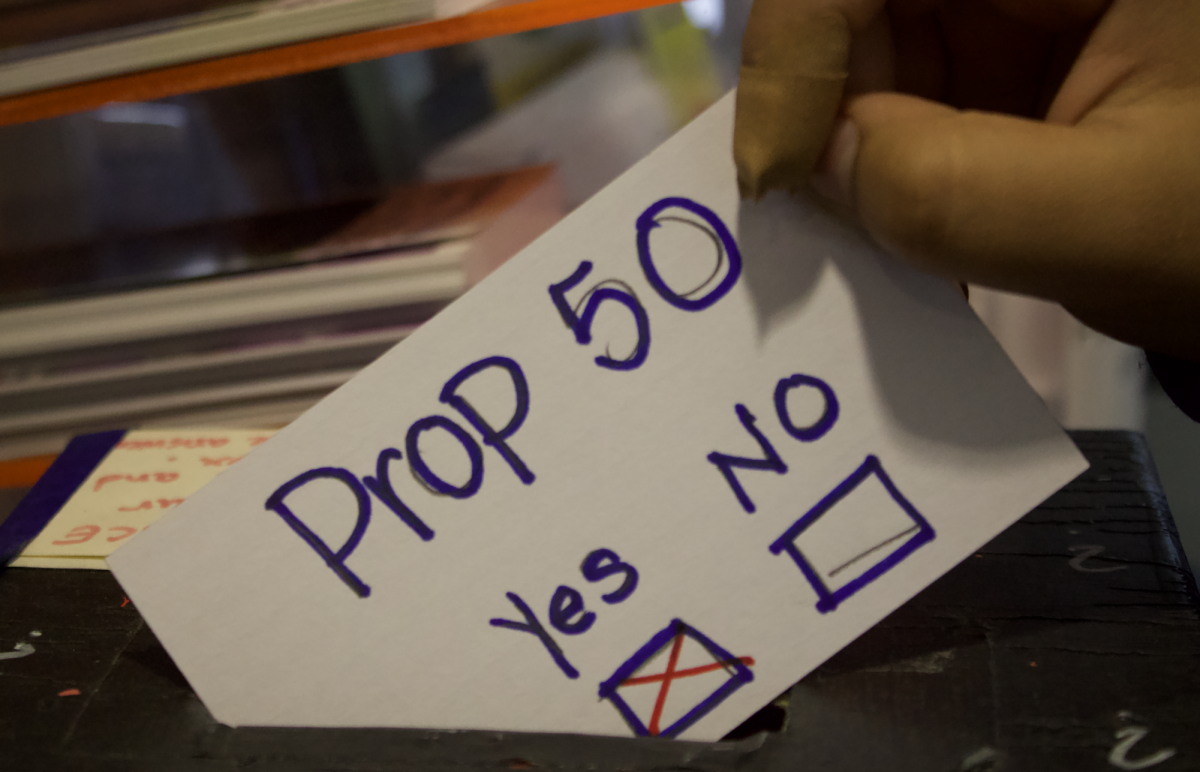
On November 4th, 2025, California voters approved Prop 50, a redistricting ballot spearheaded by Governor Newsom. The proposition allows the legislature to redraw congressional districts mid-decade, rather than waiting for the 2030 census, a dramatic shift for a state long opposed to partisan redistricting. Far from an independent reform, Prop 50 marks California’s entry into an escalating national battle over gerrymandering, one driven by short term advantage at the expense of democratic integrity.
The escalation began months earlier, when the Trump administration sought to prevent expected midterm losses. Since World War II, the sitting president’s party has almost always lost House seats in the midterms, and President Trump—whose approval rating has fallen to 39% according to The Economist—is unlikely to break that pattern. Determined to avoid a loss of House control, the administration backed an unprecedented mid-decade redistricting plan in Texas, carried out by the Republican controlled legislature and approved by Governor Abbott. Despite fierce Democrat opposition, the bill was fast tracked through procedure and approved along party lines, and is expected to give Republicans five additional seats in 2026. This move by Texas—America’s second most populous state—carried clear national implications.
California’s Prop 50 is a direct response to Texas’s move. Democrats nationwide criticized the Texas plan as a blatant power grab, but California Democrats quickly adopted the same tactic, recognizing both an incentive and an opportunity to respond in a state with equally high national stakes. Newsom, already positioning himself as a potential 2028 contender, defended the proposition by saying the state must “fight fire with fire.” In the short term, the new maps helped Democrats, who captured 64 percent of the statewide vote.
Gerrymandering itself is not new. For decades, both parties have manipulated district lines to protect or gain seats. In 2019, the Supreme Court ruled in Rucho v. Common Cause that partisan gerrymandering is a political question outside the jurisdiction of federal courts, effectively leaving states to decide. What is new, however, is the embrace of mid-decade redistricting. Changing district lines not after a census, but whenever a party has the leverage to do so breaks a long standing tradition and opens the floodgates to constant politically motivated map drawing.
But Prop 50 has also fired the starting pistol for other states to follow suit. States including North Carolina, Missouri, Ohio, and Utah have already begun drawing new maps, and several others are considering similar measures. This once controlled practice is turning into a continuous partisan arms race.
This explosion in mid-decade gerrymandering reflects a broader trend in American politics: extreme polarization fueled by online echo chambers, antagonistic political rhetoric, and a media environment that rewards outrage has turned bureaucratic political skirmishes into zero sum warfare. In this landscape, parties increasingly view any tool as fair game if it helps them win, even if it damages the system as a whole.
The long term consequences are severe. Gerrymandering erodes democratic accountability, where heavily partisan districts encourage heavily partisan representatives. It can also produce outcomes that do not reflect the true preferences of a state’s voters. Once states begin redrawing maps whenever it becomes politically convenient, the incentive to govern responsibly collapses across the board.
America now faces a critical question, will states continue escalating into a perpetual redistricting war, or will they find a way to end the cycle and establish guardrails around one of the most dangerous components of representative democracy?
If the current “fight fire with fire” approach continues, the damage will be long lasting. Both parties risk undermining the legitimacy of House elections for years to come, and voters may ultimately find themselves with representatives chosen not by the people, but by the politicians who drew the lines.